
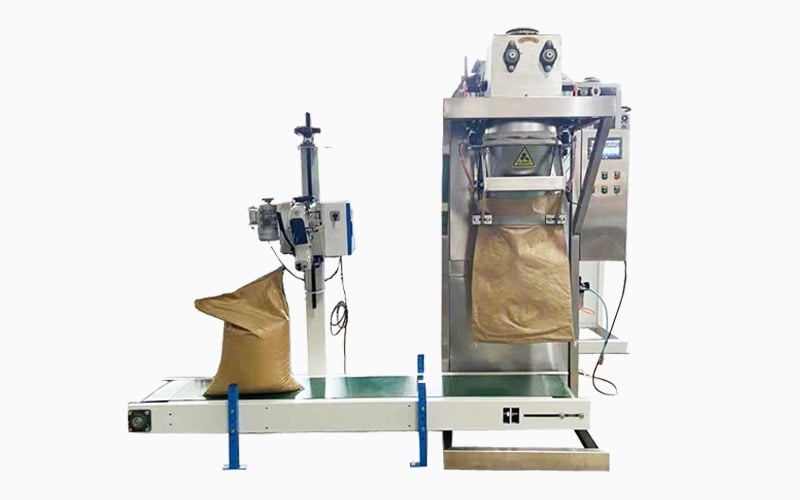
Fully automated bagging lines require massive capital expenditure and demand highly uniform bag types. Conversely, entirely manual bagging operations cannot sustain the volume required by modern B2B supply chains. For facilities processing 5 to 50kg bags, a semi-automatic bagging system provides the optimal balance of high-speed mechanical output and flexible human operation.
The Human-Machine Collaboration Model
The PM-F-50 Large Bag Packaging Machine operates on a hybrid workflow. An operator manually places the empty bag onto the clamping mechanism. This allows the facility to run various bag materials—woven polypropylene, multi-wall paper, or heavy-duty polyethylene—without reprogramming complex robotic end-effectors.
Once the operator secures the bag, the machine’s automation takes over instantly.
Photoelectric Induction Unloading
Standard semi-automatic machines require the operator to press a foot pedal or push a button to initiate the fill cycle, introducing a fraction of a second of lag every time. Over a standard 8-hour shift, these cumulative delays reduce total output.
The PM-F-50 eliminates this manual trigger via photoelectric induction.
Sub-Second Response: As soon as the bag is clamped into the correct position, the photoelectric sensor registers its presence and triggers the automatic unloading sequence with a response time of less than 0.3 seconds.
High-Volume Output: Powered by an AC 220/380V (50HZ) electrical draw and requiring an air consumption of 0.4-0.8 MPa for the pneumatic clamping and gate systems, this rapid actuation allows a single operator to achieve a packing speed of 180 to 300 bags per hour.
By automating the dispensing trigger and relying on a human operator solely for bag placement, facilities maximize output speed without sacrificing packaging flexibility.
5. Increase your bagging throughput today. Consult with our technical team to determine the exact air compressor requirements and utility layouts necessary to deploy the PM-F-50 on your factory floor.
