
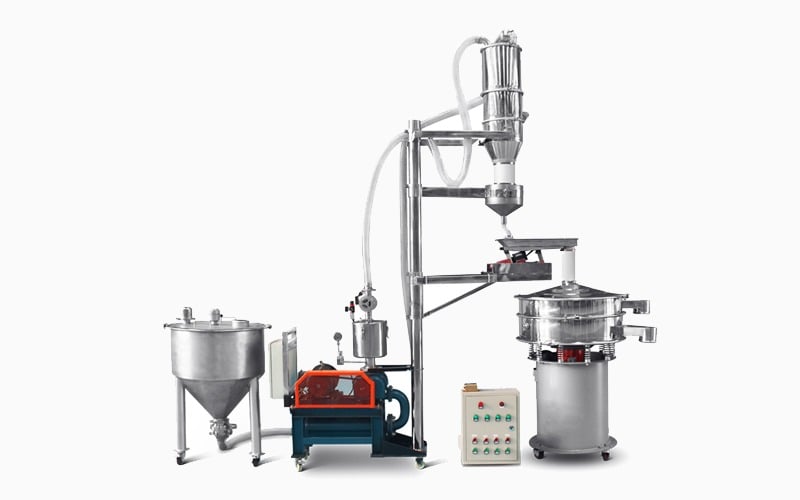
Mounting heavy auxiliary equipment above a high-frequency rotary vibrating screen presents direct structural challenges. Vibration transfer causes premature metal fatigue and destabilizes vacuum seals. Furthermore, discharging varying bulk materials requires specific mechanical geometries. When engineering a vacuum conveyor and vibrating screen assembly system, specifying the correct mounting hardware and valve type dictates long-term mechanical reliability.
Structural Fixation Methods
To isolate the vacuum hopper from the kinetic energy of the screen beneath it, the system must utilize independent support structures. Based on facility layout and maintenance requirements, engineers specify one of three mounting frameworks:
Cylindrical Brackets: Rigid, fixed-height supports mounted directly to the floor or adjacent structural beams. Ideal for static, single-product lines where vertical clearance is not an issue.
Hand-Crank Brackets: Incorporate a mechanical lifting column. Operators can manually raise the vacuum hopper, providing immediate clearance for rapid screen mesh changes or deep sanitation between batches.
Gantry Frames: Heavy-duty, standalone bridging structures. These are mandatory when suspending massive, high-capacity vacuum hoppers over large industrial screens, ensuring zero weight load is transferred to the screening chassis.
Selecting the Discharging Valve
The valve at the base of the vacuum conveyor must maintain a hermetic seal during suction and provide unobstructed material flow during discharge. The specification depends on the material profile, conveying heights, and conveying distances.
Turning Door (Flap Valve): Actuates rapidly to drop the entire batch at once. Highly effective for powders that tend to bridge or pack under pressure.
Butterfly Valve: Provides a tight seal for free-flowing granules.
Rotary Valve: Designed for controlled, metered discharge rather than batch dropping. Required when conveying material over extreme distances or when the downstream process demands a slow, continuous trickle feed.
Proper specification of these mechanical components prevents layout clashes and guarantees reliable material flow shift after shift.
5. Ensure your hardware specifications match your production reality. Download our structural CAD files to evaluate the dimensions of our gantry frames and vacuum conveyor valve assemblies.
