
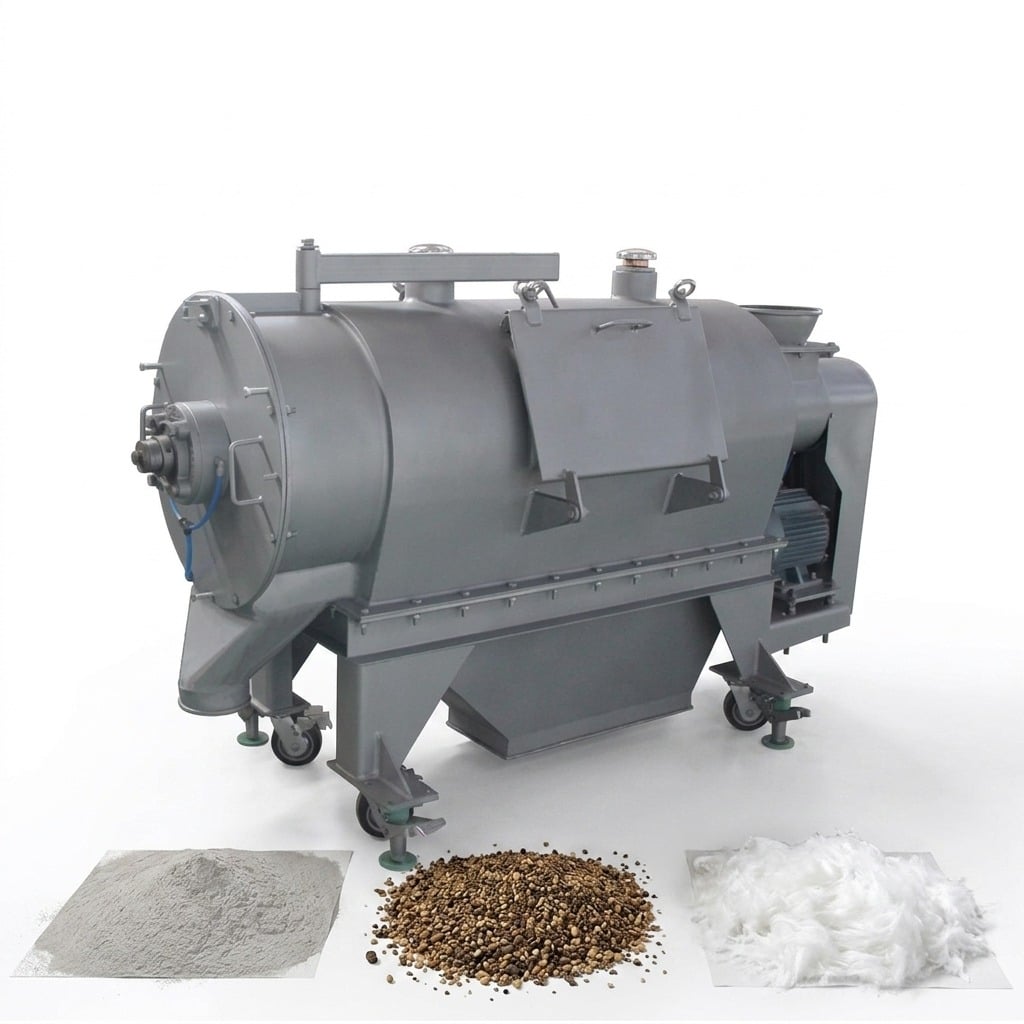
In high-volume B2B manufacturing, equipment bottlenecks dictate your maximum revenue. For plants producing fine chemicals, food additives, or metal powders, the bottleneck is almost always the screening phase. Hitting a tight specification at ≤325 mesh size severely limits the capacity of traditional sifters.
To increase overall factory throughput without expanding the physical footprint of the production line, process engineers specify centrifugal sifters. By weaponizing airflow, these units force material through fine meshes faster and cleaner than gravity alone ever could.
Versatility Across Extreme Material Profiles
The ROI of a centrifugal sifter lies in its versatility. Because the working principle relies on atomizing the material and using wind wheel blades to generate centrifugal force, the machine does not care if a powder is highly static, naturally sticky, or extremely lightweight.
This mechanical advantage allows a single machine type to be deployed across radically different industrial sectors:
Agrochemicals and Minerals: Efficiently handles harsh, dense materials like pesticide powder, clay powder, graphite powder, and gold powder.
Food and Pharmaceuticals: Provides sanitary separation for sensitive organics, including konjac powder, starch, Chinese medicine powder, and wood powder.
Industrial Chemicals: Powers through sticky or reactive compounds like calcium hydroxide powder, phosphor powder, and active calcium powder.
Engineering for Longevity
Processing abrasive materials like quartz sand powder or fly ash requires heavy-duty construction. The centrifugal sifter chassis is built to handle constant internal abrasion. Plant managers can spec the units in high-grade stainless steel for corrosive or food-grade applications, or heavy carbon steel for standard industrial mineral processing.
By continuously pushing oversize materials along the cylinder wall and out the coarse discharge port, the system prevents heavy particle build-up, reducing wear on the internal mesh cylinder and extending the lifespan of your consumables.
