
Analyzing a sample with a broad particle size distribution usually requires multiple sequential tests. You run the material through a coarse mesh, weigh the retained fraction, swap the screen, and run it again. This manual swapping eats up valuable R&D hours and introduces the risk of sample loss or contamination between steps.
For industries dealing with complex abrasives, pigments, and food powders, efficiency dictates that a single batch must be fully graded into all required fractions in one operational cycle.
The Advantage of Vertical Multi-Deck Screening
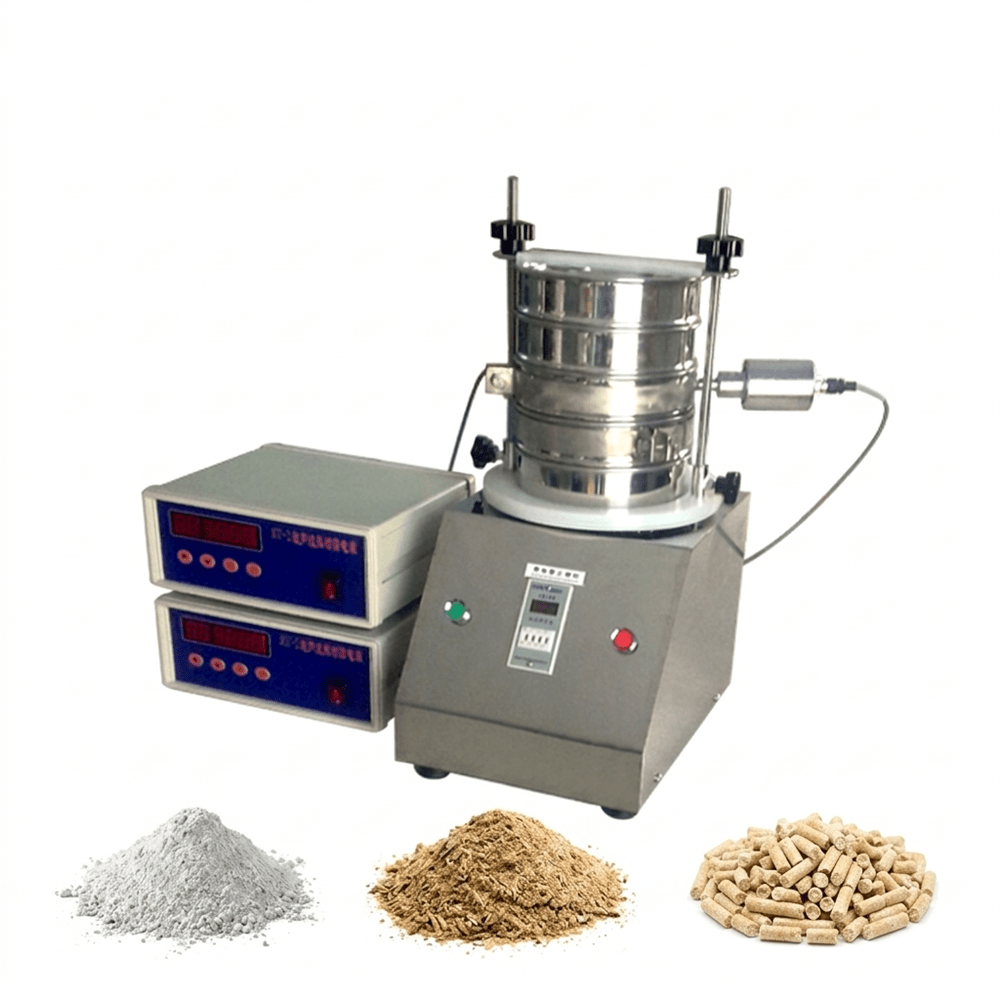
The solution is vertical stacking. As shown in the component diagram in image_52e03a.jpg, the Chenwei test sieve uses an extended screw rod (part #8) and a top pressing plate (part #13) secured by fixed bolts (part #1).
This robust clamping system allows laboratories to stack anywhere from 1 to 8 distinct screen decks on a single machine.
How it works: Place the coarsest mesh at the top and the finest at the bottom, just above the collection pan.
The result: Pour up to 300g of raw material into the top. Set the built-in timer. Walk away. The 1450 r/min vibration stratifies the entire batch simultaneously. When the cycle ends, you have up to 8 perfectly separated fractions ready for immediate weighing and analysis.
Handling Extreme Ranges
Because the CW series handles particle sizes from 20mm down to 0.038mm, an 8-deck configuration gives metallurgical or geological labs incredible analytical resolution. You can map out the exact distribution curve of a mined ore or a synthetic abrasive in a matter of minutes, not hours.
The variable height equation for the machine dimensions—listed as 400x300x(300+Nx50) for the CW-200, where ‘N’ represents the number of decks—shows exactly how scalable this system is based on your daily testing requirements.
