
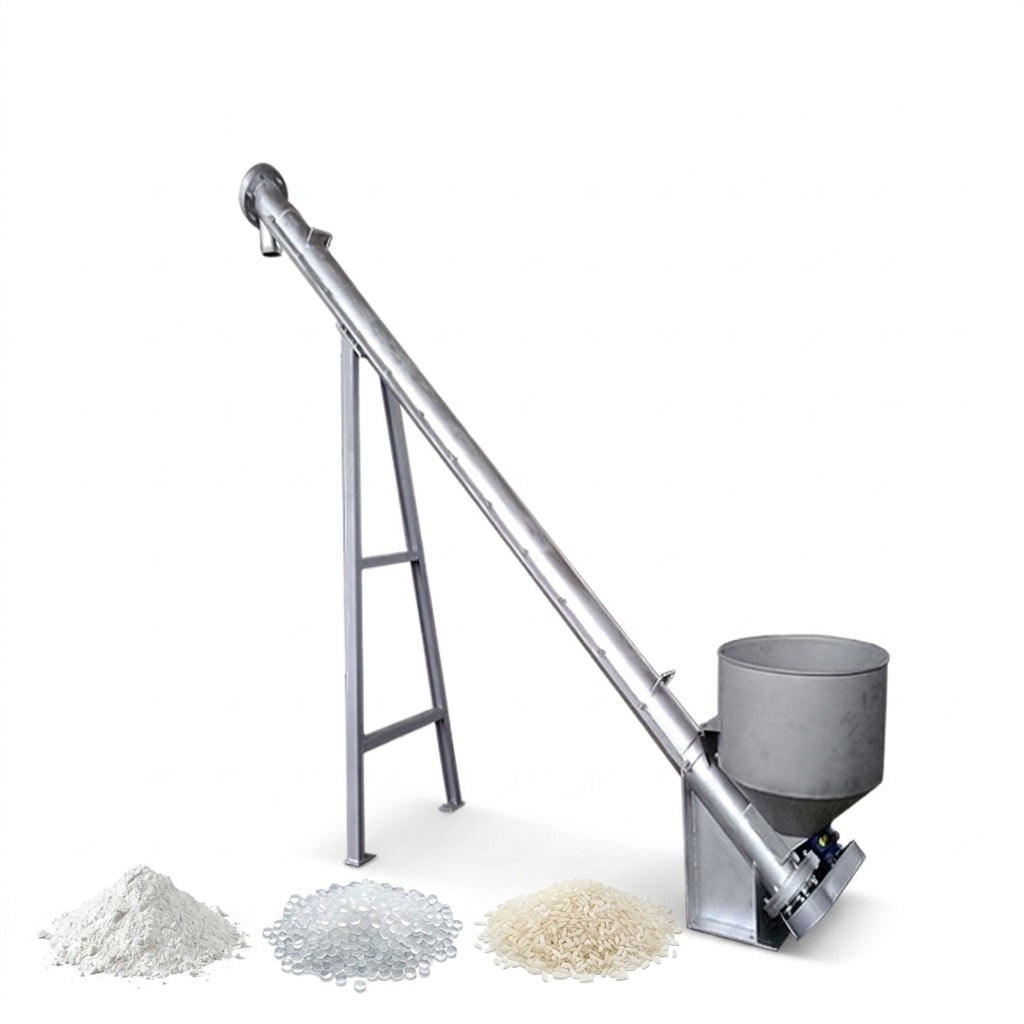
Factory floor space is expensive. When production lines require moving granular or small block materials from a floor-level discharge up to an elevated hopper or mixer, plant engineers must solve for verticality. Bucket elevators are notoriously difficult to clean and maintain, and inclined conveyor belts require massive linear floor space to achieve the required lift angle.
The tube screw conveyor provides a compact, aggressive solution for moving material against gravity.
Overcoming Gravity Through Pitch and Power
The core engineering challenge of inclined conveying is material rollback. If the angle is too steep or the screw design is flawed, the powder simply cascades back down the tube.
The working principle outlined in image_36d6a8.jpg dictates that the force driven by the motor must be greater than the material’s own gravity. In a tube screw configuration, the enclosed casing prevents the material from escaping outward, forcing it to travel up the screw flights.
To maintain efficiency on an incline, the internal screw pitch must be carefully matched to the tube diameter.
Smaller units like the CWLS-133 utilize a tight 115 mm pitch at 140 r/min to rapidly push 3 m³/h up inclines.
Mid-range models like the CWLS-273 use a 250 mm pitch at 88 r/min to manage heavier granular loads, delivering 20 m³/h.
Layout Flexibility
Because these machines are suitable for either horizontal or inclined conveying, they offer immense layout flexibility. The structural frames shown in image_36d6a8.jpg demonstrate units mounted on wheeled, angled chassis, allowing operators to position the discharge spout directly over elevated receiving tanks.
This makes them highly effective for feeding downstream equipment in tight footprints, whether you are transferring dry fly ash into a silo or moving dense sewage sludge into a processing centrifuge.
