
Mesh number tells you which designation to order. It does not tell you whether your slurry will pass through it at a usable rate. Those are two separate decisions, and they are usually made in the wrong order.
By CHENWEI · October 29, 2026 · 5-minute read
TL;DR
- Choose the aperture from the largest particle the product must not contain, then convert to a mesh number using ASTM E11 nominal values.
- A 200 µm contaminant needs a screen finer than 200 µm, which in practice means No. 80 at 180 µm rather than No. 70 at 212 µm.
- Finer cloth reduces open area and raises flow resistance, so the same machine passes far less at 325 mesh than at 40 mesh.
- Fine cloth needs backing and a cleaning routine; both are specification items, not afterthoughts.
Most filter mesh problems start with the number being chosen for the wrong reason: because it is the finest the machine offers, because a previous supplier used it, or because a specification says “400 mesh” without saying what that mesh has to stop. Working from the particle backwards avoids all three.
Start From the Particle That Must Not Pass
The aperture is set by the defect, not by the product. If a coating must be free of grit above 200 µm, the screen has to be finer than 200 µm, otherwise a 200 µm particle can pass and the filter has done nothing. Under ASTM E11, No. 70 is 212 µm and No. 80 is 180 µm, so the choice is No. 80.
| Mesh | Nominal aperture | What it stops |
|---|---|---|
| 4 | 4.75 mm | Skins, lumps, coarse agglomerates |
| 20 | 850 µm | Coarse grit, dried flakes |
| 40 | 425 µm | General straining before use |
| 80 | 180 µm | Grit that would show as a surface defect |
| 150 | 100 µm | Fine filtration of coatings and glazes |
| 325 | 45 µm | Fine filtration, low flow per unit area |
| 500 | 25 µm | Finest published range on a 450 filter |
The same logic runs the other way for a product specification. If the requirement is “no particles above 150 µm”, a screen at exactly 150 µm leaves no margin, because aperture tolerance and wire diameter both eat into the open area. Step one designation coarser and state both numbers in the quality plan.
Then Check That the Liquid Can Pass It
A mesh the particles fit through is not necessarily a mesh the liquid will pass at a useful rate. Flow through a woven cloth depends on open area, and open area falls as the cloth gets finer: the wires occupy a larger share of the surface, and the openings are shorter in both directions.
Viscosity compounds it. A suspension that pours like milk crosses a 150 µm cloth quickly; a paste that needs a spatula does not, because the resistance of the liquid in each opening rises with viscosity and the head above the deck is finite. Solids loading adds a third effect, since retained material builds a cake that further restricts flow.
That is why a small filter with a light drive is a batch tool. At 325 or 500 mesh, the rate per batch is set by the liquid and the cake, and a larger motor would not change the physics; it would only add wear.
Fine Cloth Needs Support and a Cleaning Plan
A 325 or 500 mesh cloth on a small deck has little mechanical strength of its own. It needs a supporting grid or a coarser backing cloth beneath it, and the way that support is arranged decides how the cloth behaves under cleaning as much as under load.
Two specification items follow. Ask what supports the cloth at the aperture you intend to run, and ask how the screen is removed for cleaning. A filter that has to be dismantled with tools for every batch change will be cleaned less often than it should be, and a partially blinded screen reads on the line as “the filter is slow” rather than as “the mesh is dirty”.
Cleaning between batches also protects against cross-contamination, which matters when the same unit filters two colours or two products. Retained cake and filtrate residue in the hopper are the usual carriers.
Test on Your Own Material
A rate quoted for water is not a rate for your slurry. Ask for a trial with two apertures — the one you calculated and one step coarser — and measure three things: litres per batch at the finer aperture, the condition of the cloth afterwards, and whether the filtrate still contains the defect you are trying to remove.
That test settles the argument that data sheets cannot. A supplier who will not run it is telling you something about the support you will get later.
Where the duty is a single very fine cut on a heavily loaded slurry, two stages usually beat one fine screen: a coarse screen ahead of the fine one removes the load that would blind it, and the fine cloth lasts longer.
What This Means for the Specification
Write the filter mesh as an aperture in microns, followed by the mesh designation, followed by the rate you expect per batch. Add the support arrangement and the cleaning method. That is four lines, and it removes almost every ambiguity from a mesh order.
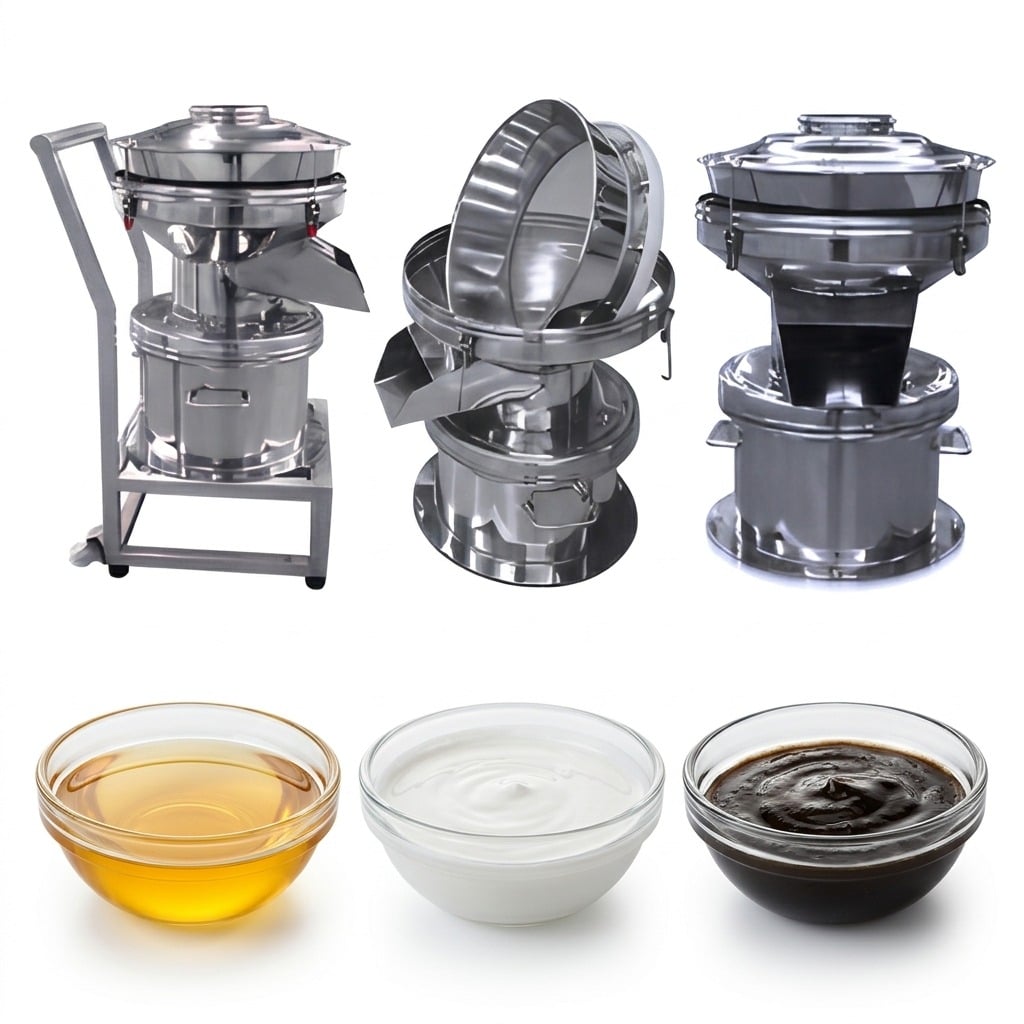
If the machine is still being chosen, the difference between a filter and a round production screen is set out in how the vibration filter and the rotary screen divide wet and dry duty, and the unit this guide is written around is described in what the 450 type vibration filter is built from. For the published range of the machine itself, the CW-450 vibration filter covers 4 to 500 mesh in one frame.
FAQ
What mesh is 100 microns?
About No. 150 under ASTM E11, which lists a 100 µm nominal aperture for that designation. Mesh numbers and microns diverge quickly, so convert rather than assume.
Is 200 mesh finer than 100 mesh?
Yes. No. 200 is 75 µm and No. 100 is 150 µm, so the higher number is the finer cloth and the lower flow rate.
How do I stop a fine filter screen from blinding?
Remove the load before it reaches the cloth: pre-strain at a coarser aperture, control solids content, and clean between batches. Support the cloth so it can be cleaned without damage.
About CHENWEI
Xinxiang Chenwei Machinery Co., Ltd. (CHENWEI Machinery) is a food processing and packaging machinery manufacturer based in Xinxiang, Henan, China. Its screening range covers rotary vibrating screens, ultrasonic vibrating screens, direct discharge screens, vibration filters and tumbler sieves for powders, granules, pastes and slurries in food, pharmaceutical and chemical production. Cutting, welding, polishing, assembly and performance testing are handled in-house, non-standard configurations are available, and machines are exported to Southeast Asia, the Middle East, Africa and South America.
