
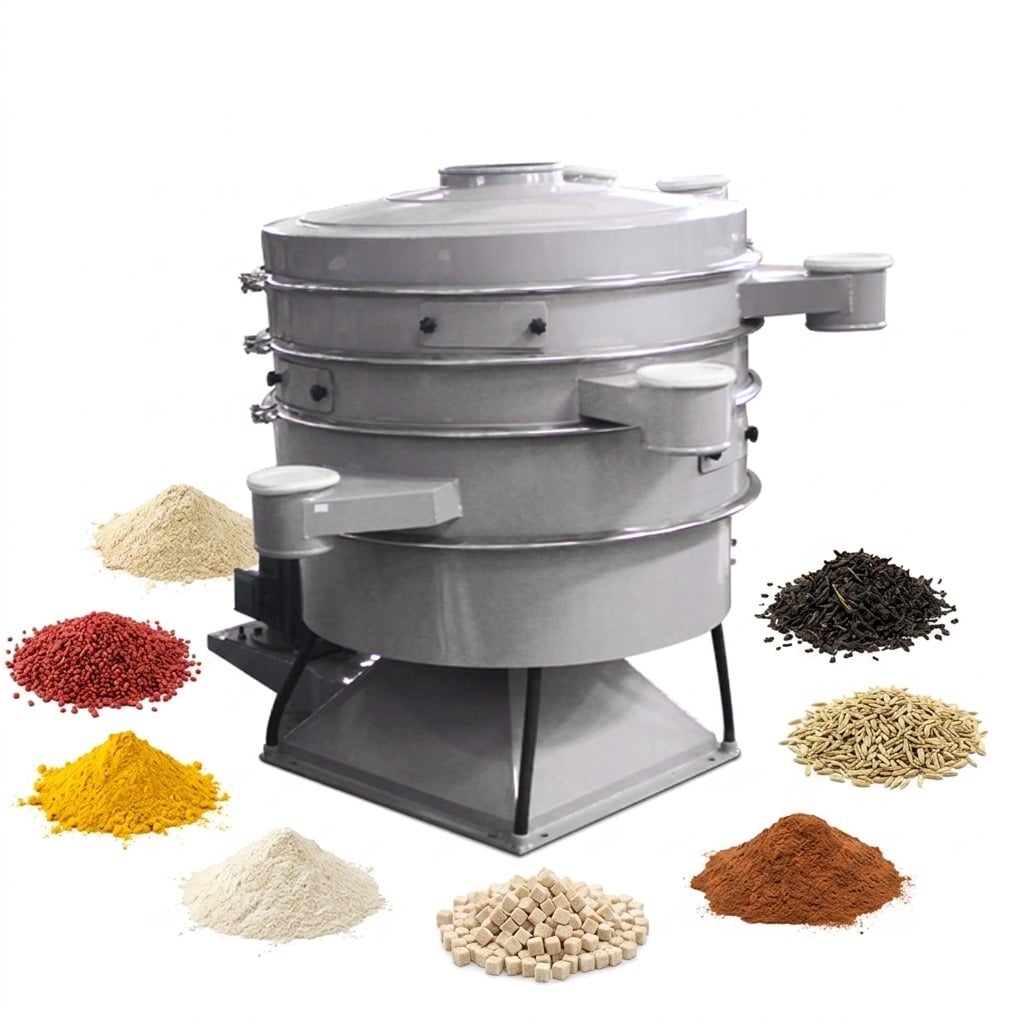
A model number is the last thing to agree, not the first. Four inputs decide which tumbler screening machine fits, and the published data sheet answers only part of the question.
By CHENWEI · October 22, 2026 · 5-minute read
TL;DR
- Four inputs decide the model: material behaviour, top feed size, how many cuts are needed, and target output.
- Effective screen area runs from 0.44 m² on the CWYS-800 to 5.30 m² on the CWYS-2600, a twelvefold spread across one range.
- Amplitude is adjustable from 20 to 70 mm and screen slope from 0 to 10 degrees; both are set for the material rather than fixed by the frame.
- Mesh range and deck count are not published for this range. Confirm both in writing before comparing quotations.
A tumbler screening machine is bought on four numbers, and only one of them is a dimension. The other three describe the material and the duty, which is why two plants with the same throughput can end up with different frames.
Four Inputs Decide the Model
Material behaviour. Whether the product is flake, spherical or granular, and whether it breaks or deforms under handling. The CWYS range is specified for awkward shapes and friable material, which is a statement about the motion rather than about capacity.
Top feed size. The range accepts particles up to 100 mm on every model. That ceiling is generous against a rotary machine, but it is a hard limit: anything above it needs reduction first.
Number of cuts. How many fractions must leave the machine in one pass. This decides how many decks the frame carries, and the deck count is not published as a fixed figure for the range.
Target output. Tonnes or kilograms per hour at the specified cut. This is the input that converts into screen area, not into frame diameter.
Screen Area Is the Number to Compare
Compare effective screen area, not outside diameter, because the two ranges are described differently in quotations.
| Model | Effective screen area | Frequency | Screen slope | Max particle size | Amplitude | Power |
|---|---|---|---|---|---|---|
| CWYS-800 | 0.44 m² | 220–280 r/min | 0–10° | ≤ 100 mm | 20–70 mm | 1.1 kW |
| CWYS-1000 | 0.64 m² | 220–280 r/min | 0–10° | ≤ 100 mm | 20–70 mm | 1.5 kW |
| CWYS-1200 | 0.95 m² | 220–280 r/min | 0–10° | ≤ 100 mm | 20–70 mm | 2.2 kW |
| CWYS-1500 | 1.65 m² | 220–280 r/min | 0–10° | ≤ 100 mm | 20–70 mm | 3.0 kW |
| CWYS-1800 | 2.40 m² | 220–280 r/min | 0–10° | ≤ 100 mm | 20–70 mm | 4.0 kW |
| CWYS-2000 | 2.85 m² | 220–280 r/min | 0–10° | ≤ 100 mm | 20–70 mm | 4.0 kW |
| CWYS-2600 | 5.30 m² | 220–280 r/min | 0–10° | ≤ 100 mm | 20–70 mm | 5.5 kW |
Moving from the smallest frame to the largest multiplies screen area by roughly twelve, while motor power rises from 1.1 kW to 5.5 kW. A single machine at the top of the range replaces several small ones.
Frequency, slope and amplitude are identical across all seven models; a quotation that varies them by frame is describing something other than this range.
What the Stroke and Slope Settings Change
Amplitude and slope together set how fast material crosses the deck and how long it stays there.
A 20 to 70 mm stroke is long by screening standards. Combined with a frequency of 220 to 280 r/min, it produces a rolling bed rather than a bouncing one. Within that range, a longer stroke moves material faster and reduces bed depth; a shorter stroke holds it on the deck longer.
Screen slope adds a second control. At 0 degrees the deck is level and residence time is longest; toward 10 degrees material moves with gravity as well as with the drive. For a product that must not be over-worked the shallow end is the starting point; for one that builds up, a steeper setting clears it.
The machine also carries a meridional and a tangential angle adjustment, covered in more detail in the explanation of how the circular and parabolic motion is produced.
Two Things the Data Sheet Does Not Answer
The published table gives area, frequency, slope, particle size, amplitude and power. It does not give a mesh range or a deck count.
Both depend on how the machine is configured: the mesh is a selection made per order, and the deck count follows from how many cuts the line needs. Two machines with the same model number can leave the works with different screens.
Ask for both in writing before signing, and state the cut in two forms: a mesh number and an aperture in microns. Mesh is a designation rather than a dimension, and the standards behind it run from 125 mm down to 20 µm (ASTM E11).
At the fine end, also ask what happens with the near-size fraction. A study of particle size distribution found particles between 0.7 and 1.0 times the aperture inhibit screening, while larger particles improve it by aiding stratification (Shen et al., 2025). If a large share of the feed sits in that band, the answer is a different machine or a different cut, not a larger frame.
What to Send Before You Ask for a Quotation
Six items shorten the exchange.
- The material, its bulk density and whether it is flake, granular or crystalline.
- Top feed size and the share of the feed near the target aperture.
- Target cut, written as mesh plus micron.
- Required output per hour, and the shift pattern.
- How many fractions must leave in one pass.
- Floor space available, and any height limit above the machine.
FAQ
How do I choose a tumbler screening machine?
Start with the material and the cut, then size the frame by effective screen area. Feed size and the number of cuts decide the deck configuration, not the diameter.
What is the largest tumbler screening machine?
In this range, the CWYS-2600, with 5.30 m² of effective screen area and a 5.5 kW motor. Every model takes feed up to 100 mm.
Can a tumbler screening machine handle fine powders?
Its application data covers granular and powder material across several industries, but this range does not publish a mesh limit. For a fine cut, confirm the achievable mesh for your model in writing.
What This Means for Your Line
The model number follows from the duty, not the other way round. Settle the material, the cut and the number of fractions first; the frame size and screen area then follow from the output you need.
If the open question is whether this machine type is right at all, the comparison against a rotary vibrating screen sets out where each one wins.
If the answer is yes, the tumbler sieve range with screen areas and motor ratings carries the full model list.
The fabrication and inspection steps behind those machines are described under how the machines are built and tested before shipment.
About Xinxiang Chenwei Machinery Co., Ltd. (CHENWEI Machinery)
Xinxiang Chenwei Machinery Co., Ltd. (CHENWEI Machinery) is a food processing and packaging machinery manufacturer based in Xinxiang, Henan, China. Its screening range covers rotary vibrating screens, ultrasonic vibrating screens and tumbler sieves for powders and granules in food, pharmaceutical and chemical production. Cutting, welding, polishing, assembly and performance testing are handled in-house, non-standard configurations are available, and machines are exported to Southeast Asia, the Middle East, Africa and South America.
Sources
- ASTM International. ASTM E11, Standard Specification for Woven Wire Test Sieve Cloth and Test Sieves.
- Shen G., Xu Z., Dong F., Wang X., Luo B., Zhang G. (2025). Effect of particle size distribution on screening efficiency of vibrating screen. Scientific Reports, 15:39677.
- Xinxiang Chenwei Machinery Co., Ltd. Tumbler Sieve CWYS series technical data sheet.
