
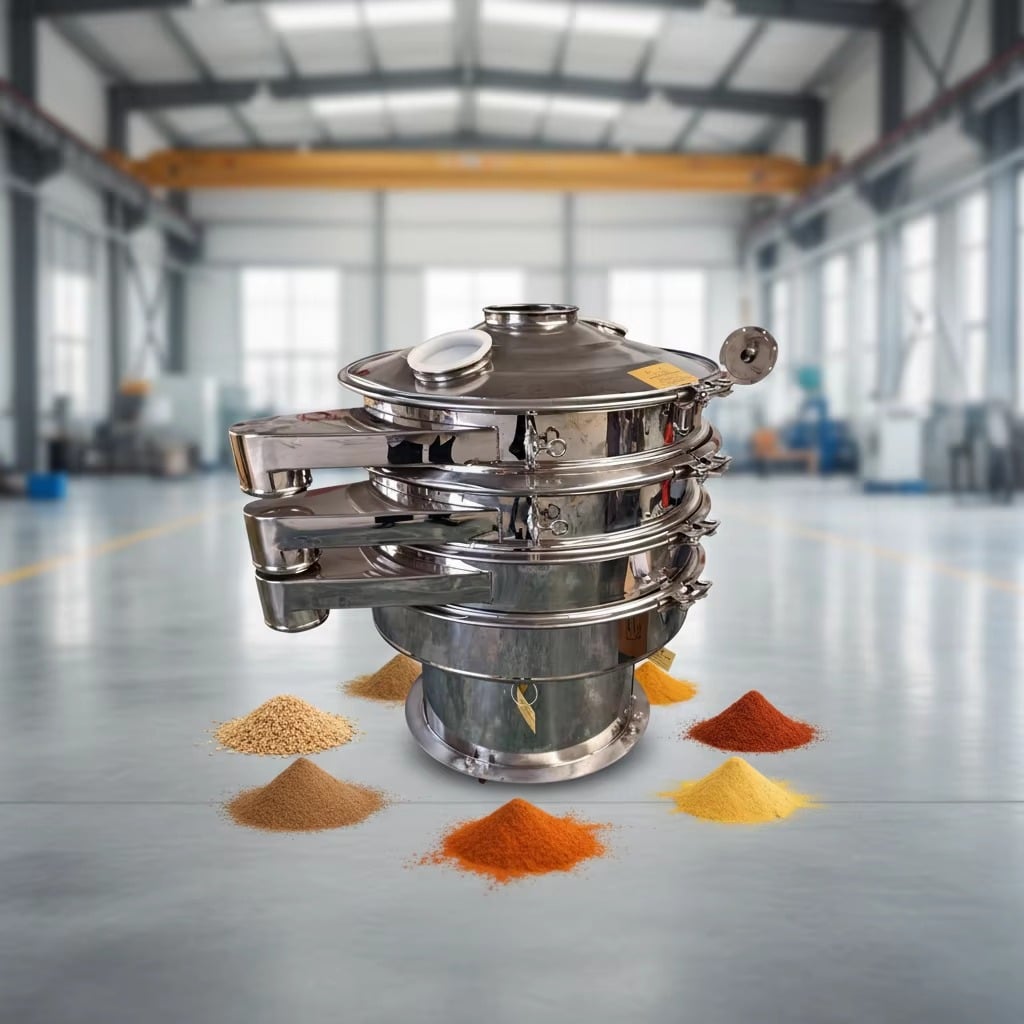
A requested throughput in tonnes per hour cannot size a screener on its own. Four inputs decide the frame diameter, the deck count and the screen area you need.
By CHENWEI · October 15, 2026 · 5-minute read
TL;DR
- A throughput figure alone cannot size a rotary vibrating screen. Capacity depends on the material, the aperture, the feed distribution and how many cuts are needed.
- Effective screen area grows with the square of the frame diameter, so a step up in size adds capacity faster than floor space.
- Deck count is a routing decision, not a capacity decision. Extra decks share one drive and add cleaning time.
- Feed size and aperture range are hard limits: 20 mm maximum feed, 3 to 500 mesh on the S49-B range.
Two plants can report the same target output for a sugar or starch line and still need different frames, because aperture, feed distribution and number of cuts differ. An enquiry answered only in tonnes per hour often produces a machine that runs below target or was oversized from the start.
Sizing a rotary vibrating screen means working backwards from four inputs before any diameter is confirmed. This guide covers those inputs, how diameter relates to usable screen area, how deck count changes the duty, and the limits no quotation can design around.
What Four Inputs Decide the Screen Size
Material behaviour. Bulk density, flowability, moisture, particle shape and whether the powder adheres or builds static charge. A light, fluffy powder passes a given aperture far more slowly than a dense granular one.
Separation aperture. State it twice: as a mesh number and as an aperture in microns. Mesh is a designation rather than a dimension, and the two are not interchangeable across standards. ASTM E11, the specification for woven wire test sieve cloth, covers nominal apertures from 125 mm down to 20 µm (ASTM E11).
Feed size distribution. The near-size fraction is the hard part. In a 2025 discrete element study of an inclined vibrating screen, particles between 0.7 and 1.0 times the aperture inhibited screening efficiency, while oversized particles improved it by aiding stratification (Shen et al., 2025). Average particle size says little about achievable capacity.
Target output and required cuts. Tonnes per hour, plus how many size fractions must leave the machine in one pass. This input decides deck count rather than diameter.
Diameter and Effective Screen Area Are Not the Same Thing
Effective screen area, not outside diameter, is the number to compare between quotations: area grows with the square of the diameter.
| Model | Nominal diameter | Decks | Effective screen area | Mesh range | Max feed size | Power |
|---|---|---|---|---|---|---|
| S494-B | Φ430 mm | 1–4 | 0.11 m² | 3–500 | < 20 mm | 0.18 kW |
| S496-B | Φ654 mm | 1–4 | 0.28 m² | 3–500 | < 20 mm | 0.45 kW |
| S498-B | Φ800 mm | 1–4 | 0.44 m² | 3–500 | < 20 mm | 0.6 kW |
| S4910-B | Φ950 mm | 1–4 | 0.64 m² | 3–500 | < 20 mm | 0.8 kW |
| S4912-B | Φ1160 mm | 1–4 | 0.95 m² | 3–500 | < 20 mm | 0.8 kW |
| S4915-B | Φ1500 mm | 1–4 | 1.65 m² | 3–500 | < 20 mm | 1.5 or 2.2 kW |
| S4918-B | Φ1768 mm | 1–4 | 2.4 m² | 3–500 | < 20 mm | 2.5 kW |
| S4920-B | Φ1950 mm | 1–4 | 2.85 m² | 3–500 | < 20 mm | 2.5 kW |
Moving from Φ800 to Φ1500 almost doubles the diameter but multiplies effective area by 3.75, from 0.44 m² to 1.65 m². A step up in diameter therefore costs less floor space than adding a second machine, and the area figure, not the nameplate diameter, is what to compare between suppliers.
How Many Decks Do You Actually Need?
Deck count is a routing decision. Each deck adds a cut, not extra capacity on the same cut.
With one to four decks available on one frame, the question is how many size fractions the line must produce in a single pass. If you only separate oversize from good product, a second deck adds cost and cleaning time without adding output. If you also need a fines fraction, the extra deck replaces a second machine and a second conveying step.
The 2025 study cited above found that a double-deck arrangement outperformed a single deck in 96.6% of tested groups under complex particle size distributions. It modelled an inclined vibrating screen rather than a round rotary machine, so treat the result as a direction rather than a specification.
Two Limits No Quotation Can Design Around
Feed size and aperture range are mechanical limits, not price points.
The S49-B range takes a maximum feed size below 20 mm and screens from 3 to 500 mesh. Coarser material must be reduced upstream. At the fine end, 500 mesh sits close to the floor of practical woven wire screening, and a powder that blinds or agglomerates needs more than a larger frame.
If your powder is fine, sticky or highly charged, diameter will not solve it: a screen that blinds passes less material no matter how much area you buy.
What to Send Before You Ask for a Quotation
These six items shorten selection and reduce the risk of a machine that does not fit the duty.
- Material name and bulk density.
- Target aperture, written as mesh plus microns.
- Particle size distribution of the feed, including the near-size fraction.
- Required output in kg/h or t/h, for the finished fraction rather than the feed.
- Number of size fractions needed per pass.
- Plant constraints: floor space, headroom, discharge height and power supply.
FAQ
How do I choose the size of a rotary vibrating screen?
Start from the aperture and the feed distribution, not the output figure. Match effective screen area to the required output, then confirm with a trial on your own material: two powders with the same bulk density can screen at different rates.
How many decks does a vibrating screen need?
One deck separates a single cut. Add decks only when the line needs more size fractions in one pass, since each deck shares one drive and adds cleaning time.
What mesh can a rotary vibrating screen handle?
The S49-B range screens from 3 to 500 mesh. If your powder blinds, agglomerates or builds static charge at fine mesh, an ultrasonic vibrating screen addresses the blinding mechanism rather than the screen area: [INTERNAL LINK: /products/ultrasonic-vibrating-screen | anchor: “ultrasonic vibrating screens for fine and cohesive powders”].
What This Means for Your Production Line
Sizing a rotary vibrating screen means matching effective screen area to a specific material, aperture and output, then confirming deck count against the cuts the line needs. Diameter is the last decision, not the first.
If output is short of target, measure what the machine passes at your working aperture and feed rate, then compare that with its effective screen area. The S49-B range runs from 0.11 m² to 2.85 m² across eight frame sizes, so [INTERNAL LINK: /products/rotary-vibrating-screen | anchor: “the full rotary vibrating screen range from 430 mm to 1950 mm”] gives you the schedule to work against.
Before changing frame size, [INTERNAL LINK: /news/how-does-a-rotary-vibrating-screen-work | anchor: “how the excitation force is set for different powders”] explains the settings that affect the result.
