
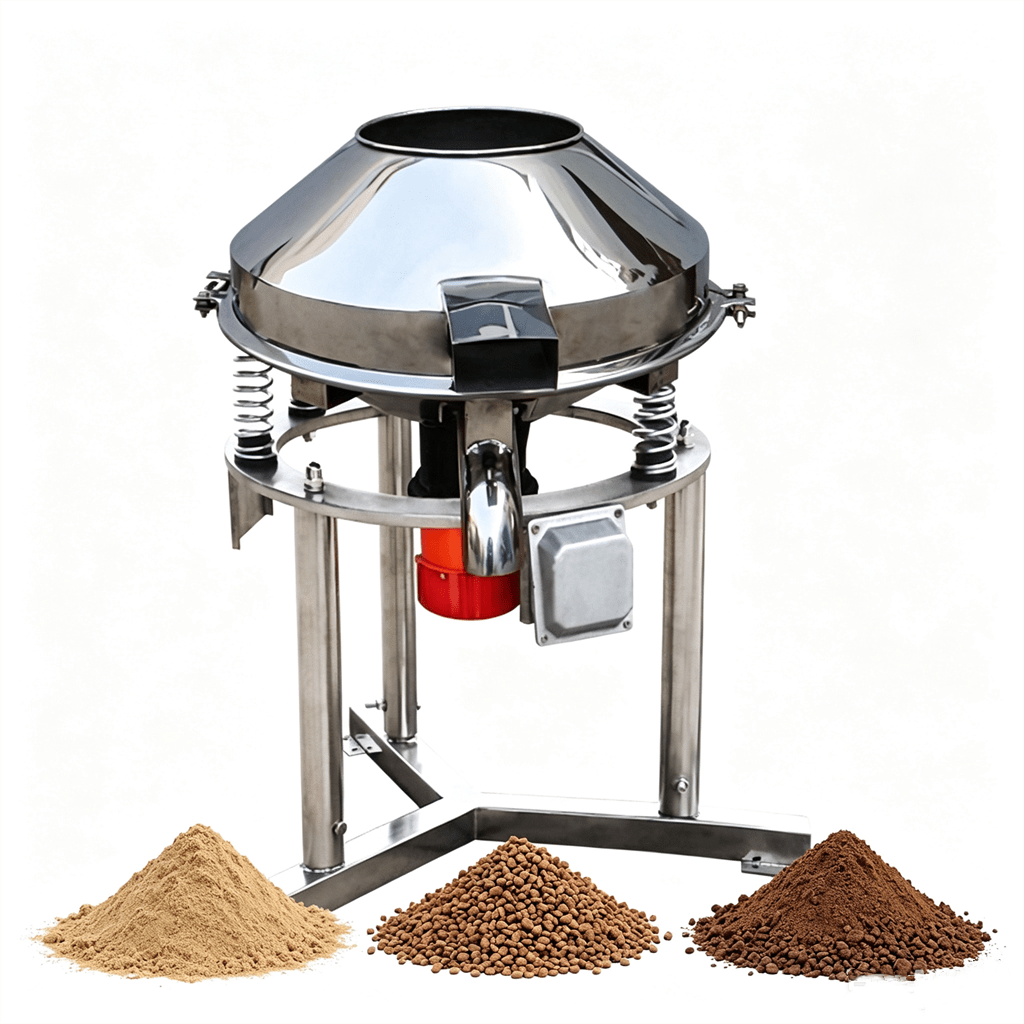
A high frequency screen is specified from the feed, not from a capacity table. Four inputs decide the size, and three questions decide whether the quotation means anything.
By CHENWEI · November 19, 2026 · 5-minute read
TL;DR
- Order the inputs: moisture first, near-size share second, cut size third, tonnage last. Moisture decides whether this family is right at all.
- The CWHF sheet publishes effective mesh diameter and motor power but no mesh range, frequency or capacity, so the specification has to be built from your feed.
- Effective area runs 0.26 to 1.06 m² across the four models, and power per square metre falls from 1.40 to about 1.04 kW/m² as the deck grows.
- Demand three figures in writing: operating frequency and amplitude, mesh range with support arrangement, and rate at your moisture content.
Start With the Feed, Not the Model
Moisture decides the family before diameter decides the model. A feed that is dry and free-flowing is a conveying problem, and a longer stroke moves it faster. A feed carrying water, clay or fines that cluster is a bed problem, and a short frequent stroke treats it better. Getting this order wrong is the expensive mistake: it buys the right size of the wrong machine.
The second input is the near-size share: the proportion of particles between roughly 0.7 and 1.0 times the intended aperture. Those particles are the ones that inhibit screening efficiency in published modelling, while particles larger than the aperture actually help by disturbing the bed (Shen et al., 2025). A feed loaded with near-size material will underperform on any machine, and no amount of extra area fixes it.
The third input is the cut, expressed as an aperture in microns. The fourth is tonnage at the moisture you actually run, not the moisture in the lab sample.
Turn the Cut Into a Mesh Number
Aperture is the specification; mesh is the ordering convention. Under ASTM E11, No. 100 is 150 µm, No. 200 is 75 µm and No. 325 is 45 µm. Two rules follow.
First, the screen must be finer than the largest particle the product may contain, with margin for aperture tolerance and wire diameter. Second, the mesh has to be one the frame and its support can carry: fine cloth on a vibrating deck needs a backing grid, and that support is part of the specification rather than an accessory.
The CWHF data sheet does not publish a mesh range, so this is a question for the supplier rather than a line to read. Ask for the range the frame can carry and the support arrangement at the fine end of it.
Size From Area, Not From the Model Number
| Model | Effective mesh | Deck area (calculated) | Motor power | Power per m² |
|---|---|---|---|---|
| CWHF-600 | 580 mm | 0.26 m² | 0.37 kW | 1.40 kW/m² |
| CWHF-800 | 780 mm | 0.48 m² | 0.55 kW | 1.15 kW/m² |
| CWHF-1000 | 960 mm | 0.72 m² | 0.75 kW | 1.04 kW/m² |
| CWHF-1200 | 1160 mm | 1.06 m² | 1.10 kW | 1.04 kW/m² |
Two habits are worth breaking here. The first is treating the model number as the mesh size: CWHF-1200 has 1160 mm of effective mesh, so the number overstates the diameter and the area by more than it looks. The second is comparing machines by power. From 960 mm upward the range settles near 1.0 kW per square metre; the smallest frame carries 40% more per unit area because a small, thin bed needs relatively more excitation.
Because the sheet publishes no capacity, area is the only handle you have. Ask the supplier for a rate per square metre at your moisture content and your near-size share, and treat any answer that is not tied to those two numbers as a guess.
Three Questions to Put in Writing
One: what frequency and what amplitude? A family named for its frequency should be able to state it. The figure also lets you calculate acceleration at the deck, which is what a fragile material responds to.
Two: what mesh range, on what support? Range plus support decides both the finest cut you can hold and how often the cloth is replaced.
Three: what rate, at this moisture, with this particle size distribution? If the supplier will not commit to a number, ask for a trial instead. A trial at production moisture is the only evidence that survives contact with the line.
One further item belongs in the same request: the exciting force in newtons, taken from the motor datasheet. The catalogue lists a force figure per model, but not in a form that can be compared with another supplier’s machine, and the numbers sit oddly against the motor ratings beside them. The motor datasheet resolves it.
What an Acceptance Test Should Show
Run the machine on production feed at production moisture for long enough to reach steady state. Sample the oversize three times and check whether it contains material that should have passed; sample the undersize and check for the contamination the screen was bought to remove. Then look at the cloth.
If the oversize carries a large near-size fraction, the screen is working as designed and the aperture is too fine for the duty. If the undersize still contains the contaminant, the screen is not doing its job at all, and the fault is upstream of the machine.
FAQ
What size high frequency screen do I need?
Start from the area the duty needs, not from the model number. Ask for a rate per square metre at your moisture and particle size distribution, then choose the smallest frame that covers it with margin.
Can a high frequency screen run dry powder?
It can, but it is not the economical choice for coarse dry tonnage, where a rotary screen with a longer stroke moves more material. For a fine dry powder that blinds below about 150 µm, ultrasonic assistance addresses the actual obstruction.
What should I get in writing before ordering?
Operating frequency and amplitude, the mesh range the frame carries with its support arrangement, the rate at your moisture content, and the exciting force in newtons from the motor datasheet.
What This Means for the Order
A high frequency screen is bought on four numbers and defended by three. The four — moisture, near-size share, cut, tonnage — belong in your enquiry. The three — frequency and amplitude, mesh range and support, rate at your conditions — belong in the quotation.
The mechanism behind the first of those questions is set out in how a high frequency screen trades amplitude for cycles, and the alternative to this family is weighed in how the high frequency screen and the rotary screen divide wet and dry duty. For the frames and motor ratings available, the CWHF high frequency vibrating screen range lists four models from 580 to 1160 mm of effective mesh.
About Chenwei
Chenwei supplies ultrasonic vibrating screens and the standard rotary vibrating screen range compared in this article, for powders and granules in food, pharmaceutical and chemical production. Machine configuration, mesh specification and test screening are matched to the material being processed, and non-standard configurations are available.